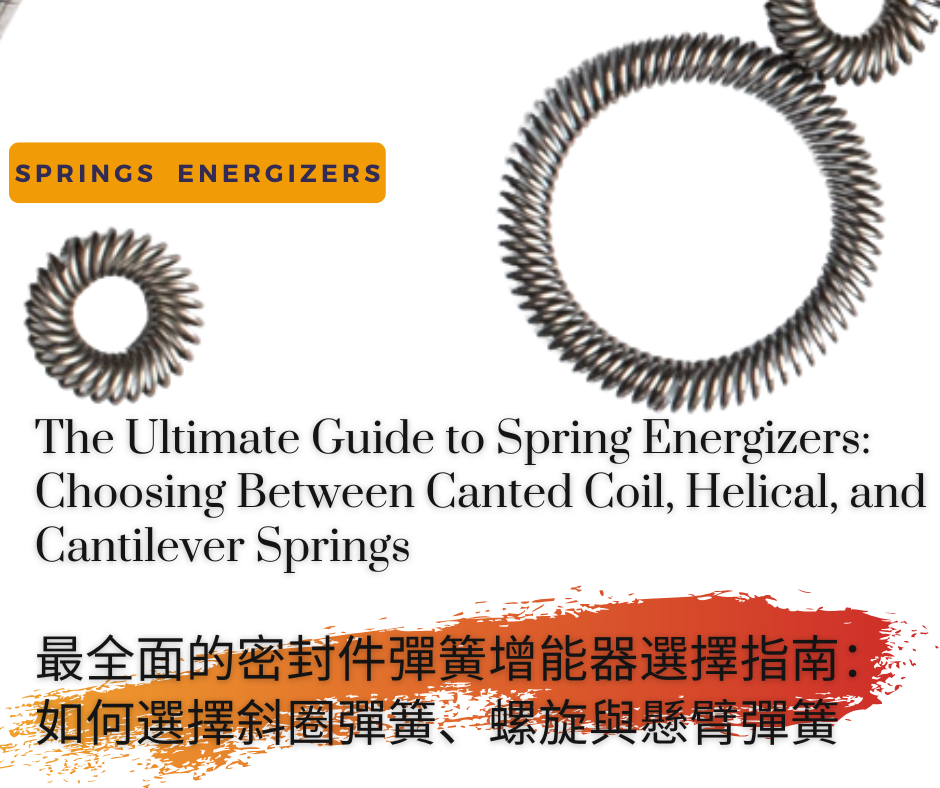
The Ultimate Guide to Spring Energizers: Choosing Between Canted Coil, Helical, and Cantilever Springs
The Ultimate Guide to Spring Energizers: Choosing Between Canted Coil, Helical, and Cantilever Springs
Spring energizers play a crucial role in modern sealing and mechanical systems, especially where performance, reliability, and longevity must be guaranteed under demanding conditions. From cryogenic valves and semiconductor tools to high-pressure pumps and precision medical devices, spring energizers provide the force, resilience, and functional stability required to keep systems operating safely.
In addition to sealing performance, canted coil springs are increasingly used in EMI/RFI shielding within high-performance electrical connectors, where vibration, shock, and thermal cycling can compromise conductivity and grounding. For more information on EMI/RFI shielding solutions using canted coil springs, see EMI / RFI Shielding in High-Performance Electrical Connectors: Design Challenges and Canted Coil Spring Solutions.
What Are Spring Energizers?
Spring energizers are metallic support elements placed inside a polymer jacket—such as PTFE, PEEK, UHMWPE, or engineered elastomers—to maintain constant sealing force or provide mechanical or electrical functionality. They ensure that the sealing lip or contact surface remains engaged even when:
-
Temperatures fluctuate
-
Pressures cycle
-
Materials expand or contract
-
Equipment vibrates
-
Wear occurs over long operating periods
Common industries relying on spring-energized technology include:
-
Semiconductor manufacturing
-
Aerospace and defense
-
LNG and cryogenics
-
Oil & gas
-
Medical devices
-
Analytical instrumentation
-
Hydrogen systems
-
Automotive and EV technologies
The right energizer type directly affects sealing performance, friction, breakaway torque, thermal response, and service life.
1. Canted Coil Springs
How They Work
Canted coil springs are manufactured with coils that lean at a precise angle (the “canted” geometry). This unique structure produces a nearly flat load-deflection curve, allowing the spring to deliver consistent force across a wide range of deflection.
This characteristic makes canted coil springs suitable for applications requiring:
-
Constant force
-
Wide tolerance absorption
-
Low friction
-
Electrical conductivity
-
EMI/RFI shielding
-
Mechanical locking
Key Performance Characteristics
-
Constant force output: Maintains uniform load over time and wear. For a detailed comparison of canted coil versus helical springs under high-vibration conditions, see Helical vs Canted Coil Springs in High-Vibration Environments. Additionally, for mechanical locking and electrical conductivity applications, see How Canted Coil Springs Enable Both Mechanical Locking and Electrical Conductivity.
-
Excellent tolerance compensation: Ideal for sealing systems with dimensional variations.
-
Low friction operation: Well-suited for precision dynamic motion.
-
Multi-functional: Can seal, conduct electricity, or serve as a mechanical latch.
-
High durability: Resists fatigue in cyclic environments.
Best Applications
-
Spring-energized PTFE seals
-
Mechanical fastening and retention
-
EMI shielding and conductive assemblies
-
Aerospace connectors
-
High-purity semiconductor equipment
-
Medical implants and instruments
-
Hydrogen and ultra-low-temperature sealing
Canted coil springs are often selected when force uniformity, long life, or multi-function performance is required.
2. Helical Springs
How They Work
Helical springs used as energizers are designed with an open-coil configuration that allows movement under axial compression. Unlike general-purpose compression springs, energizer-style helical springs are precision-engineered for sealing systems.
They generate a progressive load, meaning the force increases predictably with deflection.
Key Performance Characteristics
-
High load capacity: Excellent for high-pressure and vacuum sealing environments.
-
Predictable force curve: Suitable when precise compression characteristics are needed.
-
Good chemical and temperature stability: When manufactured from stainless steel or high-performance alloys.
-
Cryogenic capability: Performs reliably in applications involving LNG, liquid nitrogen, or helium.
Best Applications
-
Rod and piston seals under high pressure
-
Cryogenic valve seals
-
Vacuum and ultra-high-vacuum applications
-
Static sealing where long-term load retention is required
-
Seal energizers for demanding industrial equipment
Helical energizers are commonly selected when the system requires high force output and strong sealing pressure.
3. Cantilever Springs
How They Work
Cantilever springs (often called V-springs, V-shaped energizers, or cantilever V-springs) use a V-profile that flexes outward under load. The geometry creates a predictable spring force ideal for many static and low-speed dynamic sealing applications.
This energizer design is simpler than canted coil or helical springs, but highly effective for targeted sealing conditions.
Key Performance Characteristics
-
Stable load response: Provides consistent return force when compressed.
-
Good for reciprocating sealing: Well-suited to slow or moderate dynamic motion.
-
Efficient in static sealing tasks: Particularly where pressure cycles occur.
-
Cost-effective: Performs reliably without the complexity of multi-functional springs.
Best Applications
-
Reciprocating sealing systems
-
Static sealing under pressure cycling
-
Medium-load PTFE or polymer seal energizers
-
General industrial sealing where simplicity and reliability matter
Cantilever energizers are commonly selected for reciprocating motion and straightforward sealing conditions.
How to Choose the Right Spring Energizer
Selecting between canted coil, helical, and cantilever springs depends on several engineering factors:
1. Required Load Behavior
-
Constant force needed? → Canted coil.
-
High load needed? → Helical.
-
Predictable moderate load? → Cantilever.
2. Motion Type
-
High precision dynamic motion: Canted coil.
-
Static or high-pressure conditions: Helical.
-
Reciprocating motion: Cantilever.
3. Functional Requirements Beyond Sealing
-
Electrical conductivity: Canted coil.
-
EMI/RFI shielding: Canted coil or helical.
-
Mechanical locking: Canted coil.
4. Operating Environment
-
Cryogenic: Helical or canted coil.
-
High temperature: Depends on alloy selection.
-
Aggressive chemicals: Depends on polymer jacket compatibility.
5. Tolerance Variation
-
Wide tolerances: Canted coil.
-
Tight machined tolerances: Helical or cantilever.
Conclusion
Canted coil, helical, and cantilever springs each deliver unique engineering advantages, and choosing the right energizer can significantly enhance sealing integrity, reduce wear, and extend system life.
-
Canted coil springs offer multi-functional performance with constant force, low friction, and versatility in conductivity and mechanical latching.
-
Helical springs provide high load output and strong sealing pressure, ideal for high-pressure or cryogenic environments.
-
Cantilever springs deliver stable and economical performance for reciprocating and static sealing systems.
With a clear understanding of these energizer types, engineers and OEMs can select the appropriate spring to optimize reliability, efficiency, and safety in their applications.
Contact Ivex for energizer selection support.