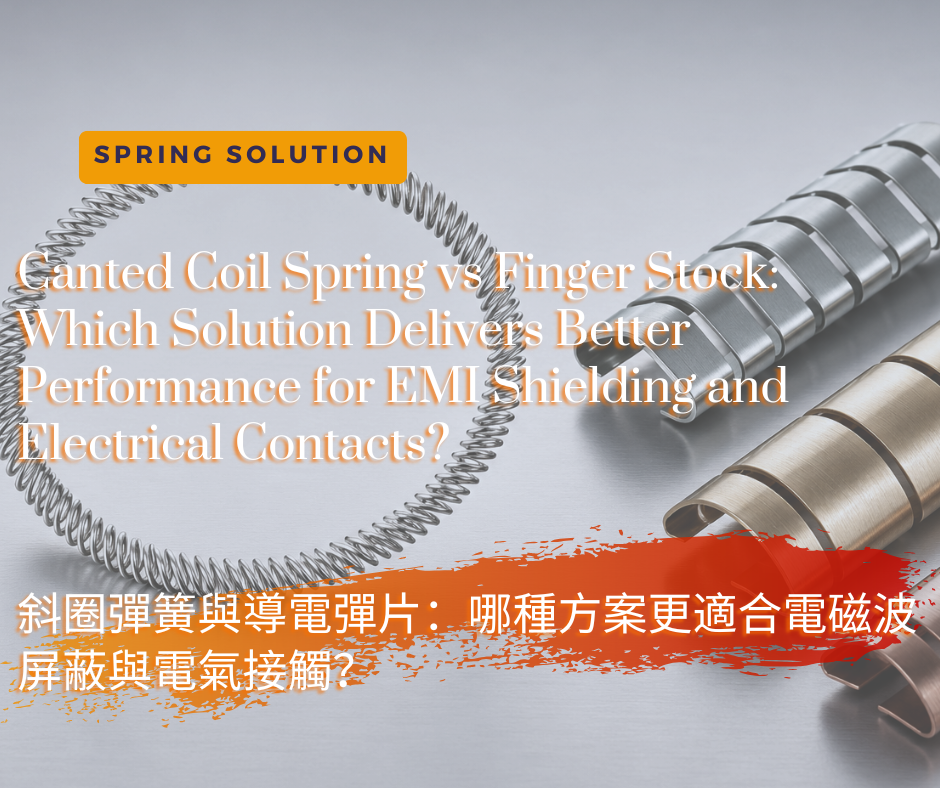
Canted Coil Spring vs Finger Stock for EMI Shielding and Electrical Contacts
Canted Coil Spring vs Finger Stock for EMI Shielding and Electrical Contacts
Introduction
Selecting the appropriate electrical contact technology is one of the most important decisions during connector design. Whether developing electric vehicle battery connectors, aerospace electronics, medical equipment, industrial automation systems, or semiconductor equipment, engineers must ensure stable electrical conductivity while maintaining long-term mechanical reliability.
Among the many contact technologies available today, Finger Stock and Canted Coil Springs are two of the most widely used solutions for maintaining electrical continuity and providing EMI/RFI shielding. Although they often serve similar functions, their mechanical behavior, force characteristics, durability, and design flexibility differ significantly.
As electronic systems continue to operate at higher currents, faster data rates, and greater power densities, connector reliability has become increasingly dependent on consistent contact force and stable electrical performance throughout the product's service life. A contact solution that performs well during initial assembly may gradually lose effectiveness after repeated mating cycles, thermal expansion, vibration, or prolonged compression.
Understanding these differences is essential for selecting the right technology for each application.
This guide provides an engineering-focused comparison between Finger Stock and Canted Coil Springs, examining their mechanical principles, electrical performance, fatigue characteristics, EMI shielding capabilities, material selection, and typical industrial applications. We will also discuss where Helical Springs and Cantilever Springs provide more appropriate solutions, allowing engineers to make informed design decisions based on actual operating conditions rather than product familiarity alone.
Why This Comparison Matters
The increasing demand for compact, high-power electrical systems has fundamentally changed connector design requirements.
Modern electrical connectors are expected to provide:
- Low and stable contact resistance
- Consistent contact force over thousands of mating cycles
- Reliable performance under vibration
- Effective EMI/RFI shielding
- Mechanical retention without excessive insertion force
- Long service life under harsh environmental conditions
These requirements have driven many industries away from conventional contact solutions toward more sophisticated spring technologies.
However, no single spring design is universally superior.
Choosing between Finger Stock and a Canted Coil Spring should never be based solely on cost or previous design practices. Instead, engineers must evaluate the complete mechanical and electrical requirements of the application.
A solution optimized for an aerospace shielding enclosure may perform poorly inside a high-current battery connector. Likewise, a spring selected for maximum electrical conductivity may not provide the insertion force characteristics required for blind-mate connector systems.
Understanding these trade-offs early in the design process can significantly improve product reliability while reducing maintenance costs and warranty failures.
Understanding the Role of Electrical Contact Springs
Electrical contact springs serve a far more complex purpose than simply connecting two conductive surfaces.
An effective contact spring must simultaneously perform several critical functions throughout the product's lifetime.
First, it must generate sufficient normal force to maintain intimate metal-to-metal contact. Insufficient force increases electrical resistance, while excessive force increases insertion effort, accelerates wear, and may damage mating components.
Second, the spring must compensate for manufacturing tolerances, thermal expansion, vibration, and mechanical movement without losing contact integrity.
Third, in many applications, the spring also contributes to EMI/RFI shielding by maintaining continuous conductive paths between mating components.
Finally, modern electrical contact springs are expected to maintain these characteristics after thousands—or even tens of thousands—of operating cycles.
This combination of electrical, mechanical, and environmental requirements explains why spring geometry is often as important as spring material. For a broader engineering framework covering contact force, resistance, materials, plating, and spring selection, see our Electrical Contact Spring Design Guide.
What Is Finger Stock?
Finger Stock is one of the oldest and most widely used conductive spring technologies for EMI shielding applications.
Typically manufactured from beryllium copper (BeCu) or stainless steel, Finger Stock consists of a continuous strip of individually formed spring fingers that deflect independently when compressed.
Each finger acts as an individual cantilever beam, producing localized contact force against the mating surface.
Because many fingers contact the opposing surface simultaneously, Finger Stock creates multiple conductive paths capable of providing effective electromagnetic shielding.
Its relatively simple manufacturing process and low material cost have made Finger Stock a standard solution for decades in applications including:
- Electronic enclosures
- Shielded cabinets
- Military equipment
- Aerospace housings
- Communication systems
- RF equipment
- Instrumentation panels
In these applications, Finger Stock provides excellent EMI performance while remaining relatively inexpensive to manufacture and install.
However, its mechanical behavior also introduces several limitations that engineers should understand before selecting it for demanding connector applications.
Unlike precision coil-based spring technologies, each contact finger experiences localized bending stress concentrated near its fixed base. Over repeated compression cycles, these stresses may gradually reduce spring force due to material fatigue or permanent deformation.
Furthermore, because contact force varies significantly with deflection, insertion force and electrical resistance may become less predictable across different operating conditions.
These characteristics do not necessarily make Finger Stock inferior—but they do influence the range of applications where it performs best.
What Is a Canted Coil Spring?
A Canted Coil Spring is a precision-engineered spring consisting of individually angled coils arranged around a continuous circular or linear configuration.
Unlike conventional compression springs, each coil is intentionally manufactured at a specific cant angle relative to the spring axis. This geometry can produce a relatively flat force-deflection response over a defined working range, depending on spring design and installation conditions.
Rather than relying on localized bending like Finger Stock, the entire spring shares mechanical loads through distributed coil deformation.
This seemingly simple geometric difference fundamentally changes how the spring behaves.
Instead of producing rapidly increasing forces as compression increases, a properly designed Canted Coil Spring maintains remarkably consistent contact force across a wide operating range.
For connector designers, this translates into several practical advantages.
Stable contact force leads to more consistent electrical resistance.
Controlled insertion force improves mating performance.
Distributed deformation can support fatigue performance when the spring is properly designed for the required load and cycling conditions.
Multiple independent contact points improve electrical continuity.
And because the spring can simultaneously provide mechanical retention and electrical conductivity, many connector designs eliminate the need for separate retention components.
Today, Canted Coil Springs are widely used in applications requiring exceptional reliability, including:
- Electric vehicle battery connectors
- Aerospace connectors
- Defense electronics
- Medical devices
- Semiconductor manufacturing equipment
- High-current power distribution systems
- Robotics
- AI server infrastructure
As connector technologies continue evolving toward higher current density and smaller package sizes, Canted Coil Springs have become an increasingly attractive solution where long-term reliability outweighs initial component cost.
Mechanical Design Differences
At first glance, Finger Stock and Canted Coil Springs appear to perform the same function. Both establish conductive contact between two mating components while providing electromagnetic shielding. However, their internal mechanical behavior is fundamentally different, and these differences directly influence connector reliability, insertion force, fatigue life, and electrical performance.
Understanding how each spring generates force is critical when selecting the appropriate solution for demanding applications.
How Finger Stock Generates Contact Force
Finger Stock is manufactured by stamping and forming a thin conductive metal strip into a series of individual spring fingers.
Each finger behaves as an independent cantilever beam. When compressed, bending stress is concentrated near the root of the finger while the free end provides the contact force.
This design offers several practical advantages:
- Simple manufacturing process
- High electrical conductivity
- Excellent flexibility for large shielding surfaces
- Cost-effective production
However, because each finger bends independently, the contact force increases rapidly as compression increases.
This behavior creates a non-linear force curve.
At low compression, contact force may be insufficient for demanding electrical applications.
At high compression, insertion force increases significantly, placing additional stress on both the spring and mating components.
This force variation becomes increasingly important in connectors requiring repeated mating cycles or precise insertion characteristics.
How Canted Coil Springs Generate Contact Force
A Canted Coil Spring operates on an entirely different mechanical principle.
Instead of bending individual spring fingers, the angled coils deform through a combination of torsion, bending, and controlled geometric rotation.
Because deformation is distributed throughout the entire coil structure, mechanical loads are shared more uniformly.
The result is a characteristic known as Nearly Constant Force.
Rather than producing rapidly increasing forces during compression, a properly designed Canted Coil Spring maintains relatively stable contact force throughout much of its working deflection.
This characteristic provides several important engineering advantages.
The connector experiences more predictable insertion force.
Electrical contact pressure remains more consistent.
Mechanical stress is distributed throughout the spring instead of concentrating at individual bending points.
Fatigue resistance is significantly improved.
These characteristics explain why Canted Coil Springs are frequently selected for mission-critical connectors where long-term reliability is essential.
Understanding Nearly Constant Force
One of the defining characteristics of a Canted Coil Spring is its ability to generate nearly constant contact force over a wide working range.
Unlike traditional spring designs that follow a rapidly increasing load-deflection curve, the unique geometry of angled coils creates a much flatter force profile.
For connector designers, this is particularly valuable because connector tolerances are rarely perfect.
Variations may exist due to:
- Manufacturing tolerances
- Thermal expansion
- Housing deformation
- Wear
- Surface irregularities
- Assembly variation
A contact system with highly variable spring force may perform differently from one assembly to another.
A nearly constant force spring compensates for these variations while maintaining stable electrical performance.
This characteristic also simplifies mechanical design because engineers do not need to optimize connector geometry around a narrow operating window.
Instead, the spring continues delivering reliable performance across a broader range of compression.
Contact Force Distribution
While overall contact force is important, force distribution is often even more critical.
In Finger Stock, each spring finger contacts the mating surface individually.
Depending on manufacturing tolerances and assembly conditions, some fingers may carry significantly more load than others.
Uneven load distribution may result in:
- Localized wear
- Higher stress concentration
- Inconsistent electrical resistance
- Premature fatigue
- Reduced shielding effectiveness
A Canted Coil Spring distributes mechanical load across multiple angled coils that continuously share deformation.
As a result, contact pressure becomes more uniform around the entire circumference or contact path.
Uniform force distribution generally produces:
- More stable electrical continuity
- Reduced localized wear
- Longer service life
- Improved reliability under dynamic loading
This difference becomes increasingly significant in connectors subjected to vibration, thermal cycling, or repeated insertion.
Insertion Force Characteristics
Insertion force is one of the most overlooked aspects of connector design.
A connector requiring excessive insertion force may:
- Damage mating components
- Increase assembly time
- Reduce operator safety
- Accelerate mechanical wear
- Create inconsistent user experience
Conversely, insertion force that is too low may lead to inadequate contact pressure and unstable electrical performance.
Achieving the proper balance is therefore essential.
Finger Stock Insertion Characteristics
Because Finger Stock follows a relatively steep load-deflection curve, insertion force typically increases rapidly during compression.
This behavior is acceptable in applications where components are assembled infrequently.
However, for connectors requiring frequent mating cycles, high insertion force may become undesirable.
In addition, the insertion force experienced by operators may vary depending on manufacturing tolerances, alignment, lubrication, and wear.
Canted Coil Spring Insertion Characteristics
The nearly constant force profile of a Canted Coil Spring produces a much more predictable insertion experience.
Instead of continuously increasing force throughout compression, the connector experiences relatively consistent resistance over the working range.
For connector designers, this provides several benefits:
- Easier blind mating
- Reduced insertion variability
- Lower operator effort
- Improved automation compatibility
- Reduced connector wear
These characteristics have made Canted Coil Springs particularly attractive in robotic assembly systems and automated manufacturing environments.
Contact Resistance
Electrical performance depends heavily on contact resistance.
Even small increases in resistance may generate significant heat when high current passes through a connector.
High contact resistance may result in:
- Power loss
- Temperature rise
- Signal degradation
- Localized heating
- Reduced connector life
- System failure
The primary objective of any electrical contact spring is therefore not simply conductivity—but maintaining stable conductivity throughout the product's lifetime.
Why Contact Resistance Changes
Many engineers assume contact resistance depends only on material conductivity.
In reality, several factors influence resistance:
- Contact force
- Surface finish
- Oxidation
- Wear
- Contamination
- Temperature
- Vibration
- Mechanical relaxation
This explains why two connectors manufactured from identical materials may exhibit significantly different electrical performance after several years of operation.
Why Stable Contact Force Matters
Electrical contact occurs only at microscopic asperities where two conductive surfaces physically touch.
Higher contact force generally increases the real contact area while reducing constriction resistance.
However, excessive force introduces new problems.
Higher stress accelerates wear.
Insertion force increases.
Mechanical fatigue becomes more severe.
Component deformation may occur.
The optimal solution is therefore not maximum force—but stable, controlled force.
This is one of the primary reasons Canted Coil Springs are widely used in high-reliability electrical systems.
Their ability to maintain nearly constant contact force allows electrical resistance to remain relatively stable despite repeated mechanical cycling.
Mechanical Retention
Modern connectors often require more than electrical conductivity.
Many also require mechanical retention to prevent accidental separation under vibration, shock, or thermal movement.
Traditional connector designs frequently rely on separate locking mechanisms in addition to electrical contacts.
Canted Coil Springs can often perform both functions simultaneously.
By carefully selecting spring geometry and groove dimensions, the spring provides predictable retention force while maintaining electrical continuity.
This integration reduces component count, simplifies assembly, and can improve overall connector reliability.
Finger Stock, by comparison, is primarily intended to provide conductive contact and shielding rather than mechanical retention.
Although it contributes frictional resistance, it is generally not designed to serve as the primary retention mechanism in high-performance connectors.
EMI/RFI Shielding Performance
For many electrical systems, maintaining electrical continuity alone is not sufficient. Modern electronic equipment must also prevent electromagnetic interference (EMI) and radio frequency interference (RFI) from entering or escaping the enclosure.
As operating frequencies continue to increase and electronic packaging becomes more compact, EMI shielding has evolved from a secondary design consideration into a critical engineering requirement.
Applications including electric vehicles, aerospace electronics, military communication systems, AI servers, medical imaging equipment, and semiconductor manufacturing tools all depend on reliable shielding to ensure stable operation.
Although both Finger Stock and Canted Coil Springs are widely used for EMI shielding, they achieve this objective through different mechanical mechanisms.
Understanding these differences allows engineers to optimize shielding performance while improving long-term connector reliability.
How EMI Shielding Actually Works
One of the most common misconceptions is that shielding performance depends solely on conductive material.
In reality, conductivity is only one part of the equation.
Effective shielding also requires continuous electrical contact between mating conductive surfaces.
Whenever a discontinuity exists, electromagnetic energy may leak through the opening.
This phenomenon becomes increasingly significant as operating frequencies rise.
For this reason, shielding effectiveness depends not only on material conductivity, but also on:
- Contact continuity
- Contact pressure
- Surface condition
- Contact spacing
- Joint geometry
- Assembly tolerances
A spring that maintains stable contact force throughout its lifetime generally produces more consistent shielding performance than one whose contact pressure gradually decreases.
Finger Stock in EMI Shielding Applications
Finger Stock has been used for decades because it offers excellent shielding performance over relatively large surfaces.
The individual spring fingers create numerous conductive paths between mating components, helping to reduce leakage around enclosure joints.
Typical applications include:
- Shielded cabinets
- Electronic enclosures
- Communication equipment
- Radar systems
- Aerospace panels
- Military electronics
Because Finger Stock can be manufactured in long continuous strips, it is particularly effective for doors, removable covers, and access panels.
For these applications, mechanical retention is usually provided by fasteners or hinges rather than the spring itself.
Finger Stock simply ensures continuous electrical conductivity around the perimeter.
This makes it an excellent solution for many enclosure designs.
However, connector applications introduce additional mechanical challenges.
Repeated insertion, vibration, wear, and dimensional variation gradually affect spring force, which in turn influences long-term shielding performance.
Canted Coil Springs in EMI Shielding
Canted Coil Springs approach shielding from a different perspective.
Rather than relying on multiple independent spring fingers, the continuous coil geometry produces a nearly uniform contact force around the entire contact path.
This offers several engineering advantages.
First, contact pressure remains relatively consistent despite manufacturing tolerances.
Second, distributed deformation reduces localized stress concentrations.
Third, stable contact force helps maintain electrical continuity throughout repeated mating cycles.
As a result, shielding performance tends to remain more stable over extended service life.
These characteristics explain why Canted Coil Springs are increasingly used in:
- High-performance circular connectors
- Military connectors
- Aerospace connectors
- High-current power connectors
- Modular electronic systems
- Rugged industrial connectors
where long-term reliability is often more important than minimizing initial component cost.
Contact Continuity Under Dynamic Conditions
Many connectors are evaluated under static laboratory conditions.
However, real operating environments rarely remain static.
Mechanical systems experience:
- Shock
- Continuous vibration
- Thermal expansion
- Thermal contraction
- Mechanical movement
- Assembly tolerances
Every movement introduces the possibility of temporary contact separation.
Even microscopic interruptions may produce intermittent electrical resistance changes.
For power connectors, this may increase heat generation.
For signal connectors, intermittent contact may degrade communication quality.
For shielding systems, discontinuous electrical paths may reduce shielding effectiveness.
Maintaining stable contact pressure under these conditions is therefore essential.
Why Vibration Causes Electrical Contact Failure
Vibration rarely breaks a connector instantly.
Instead, failure usually develops gradually.
Repeated mechanical movement produces microscopic sliding between contact surfaces.
This process is known as micro-motion.
Although the movement may only measure a few micrometers, it repeatedly disrupts the protective oxide layer on metallic surfaces.
Fresh metal becomes exposed.
Oxidation begins again.
Wear particles accumulate.
Contact resistance gradually increases.
Eventually, electrical performance becomes unstable.
This phenomenon is commonly associated with fretting corrosion, one of the leading causes of long-term connector degradation.
Understanding Fretting Corrosion
Fretting corrosion is often misunderstood because corrosion itself is not the primary problem.
The underlying cause is repeated micro-motion between contacting surfaces.
As microscopic movement continues:
- Protective surface films are removed.
- Fresh metal is exposed.
- Oxidation occurs.
- Wear debris accumulates.
- Contact resistance increases.
- Localized heating develops.
Once the process begins, it often accelerates over time.
The resulting debris may further increase abrasion while reducing the effective conductive contact area.
Eventually, connector performance becomes unpredictable.
How Stable Contact Force Reduces Fretting
Completely eliminating vibration is rarely possible.
Instead, connector designers attempt to minimize relative motion between contact surfaces.
Stable contact force plays an important role.
When normal force remains consistent, microscopic movement becomes smaller.
Reduced movement decreases wear.
Lower wear slows oxidation.
Electrical resistance remains more stable.
For this reason, nearly constant force springs often demonstrate improved long-term reliability in vibration-intensive environments.
This does not mean that Canted Coil Springs eliminate fretting corrosion.
Rather, their mechanical behavior helps reduce one of the primary driving mechanisms responsible for its development.
Fatigue Life
Every spring has a finite service life.
The question is not whether fatigue will occur.
The question is how quickly it develops.
Fatigue failure originates from repeated cyclic stress.
Whenever a spring is compressed, released, or subjected to vibration, microscopic structural changes occur within the material.
Eventually, tiny cracks begin forming at locations experiencing the highest stress concentration.
As cycling continues, these cracks slowly propagate until the spring no longer performs as intended.
The geometry of the spring strongly influences where these stress concentrations develop.
This is why two springs manufactured from identical materials may exhibit dramatically different fatigue lives.
Why Geometry Matters More Than Material
Engineers often focus first on material selection.
Should the spring be manufactured from:
- Beryllium Copper
- Stainless Steel
- Elgiloy
- Inconel
- MP35N
Material certainly matters.
However, geometry often influences fatigue life even more.
A poorly designed spring manufactured from premium material may fail earlier than a properly engineered spring made from a more conventional alloy.
This principle explains why spring geometry should always be evaluated before simply selecting a stronger material.
The way mechanical stress is distributed throughout the spring frequently determines long-term durability more than tensile strength alone.
Material Selection for Electrical Contact Springs
Selecting the appropriate spring geometry is only one part of designing a reliable electrical contact system. Material selection is equally important because the spring must continue delivering consistent mechanical force while maintaining stable electrical performance throughout its service life.
There is no universal spring material suitable for every application.
Instead, engineers should evaluate the operating environment before selecting a material.
Important design considerations include:
- Operating temperature
- Humidity
- Corrosive chemicals
- Required electrical conductivity
- Mechanical fatigue
- Required spring force
- Magnetic properties
- Weight restrictions
- Cost objectives
- Regulatory requirements
The optimal material represents a balance between mechanical performance, environmental resistance, manufacturability, and lifecycle cost.
Beryllium Copper (BeCu)
Beryllium Copper remains one of the most widely used materials for electrical contact springs.
Its popularity results from an excellent combination of electrical conductivity, mechanical strength, fatigue resistance, and corrosion resistance.
Advantages include:
- Excellent electrical conductivity
- High fatigue strength
- Good corrosion resistance
- Stable spring properties
- Excellent EMI shielding performance
Typical applications include:
- Finger Stock
- Electrical contacts
- RF shielding
- Aerospace electronics
- Military connectors
However, engineers should also recognize that BeCu requires careful handling during manufacturing due to health considerations associated with airborne beryllium particles generated during machining or grinding. Finished components are generally safe when properly manufactured.
Stainless Steel
Stainless steel is frequently selected when corrosion resistance and mechanical durability are more important than maximum electrical conductivity.
Compared with BeCu, stainless steel generally exhibits:
- Lower electrical conductivity
- Excellent corrosion resistance
- High mechanical strength
- Good fatigue life
- Lower material cost
For this reason, stainless steel is commonly used in applications where the spring primarily provides mechanical loading rather than serving as the primary conductive path.
Elgiloy®
Elgiloy is a cobalt-chromium-nickel alloy developed for extremely demanding environments.
Its advantages include:
- Exceptional fatigue resistance
- Outstanding corrosion resistance
- Stable spring characteristics over a wide temperature range
- Excellent stress relaxation resistance
These properties make Elgiloy particularly suitable for aerospace, medical, and high-reliability industrial systems where long service life is critical.
Inconel®
Inconel is widely recognized for its ability to maintain mechanical properties at elevated temperatures.
Unlike many conventional spring materials, Inconel retains strength under prolonged thermal exposure.
Typical applications include:
- Aerospace engines
- Energy systems
- High-temperature connectors
- Oil and gas equipment
- Downhole tools
When operating temperatures exceed the capabilities of conventional alloys, Inconel often becomes the preferred material despite its higher cost.
MP35N®
MP35N is frequently selected for highly specialized applications requiring exceptional corrosion resistance combined with high mechanical strength.
Industries utilizing MP35N include:
- Medical implants
- Aerospace
- Defense
- Offshore energy
- Marine systems
Although significantly more expensive than conventional alloys, its long-term reliability often justifies the investment for mission-critical equipment.
Surface Plating Considerations
Spring performance depends not only on the base material but also on surface finish.
Surface plating influences:
- Contact resistance
- Corrosion resistance
- Wear resistance
- Fretting performance
- Solderability
- Long-term electrical stability
Proper plating selection can dramatically improve connector performance without changing the underlying spring geometry.
Gold Plating
Gold provides excellent corrosion resistance because it does not readily oxidize under normal service conditions.
Advantages include:
- Extremely stable contact resistance
- Excellent corrosion resistance
- Reliable low-current signal transmission
- Long service life
For precision signal connectors where stable electrical performance is essential, gold plating remains one of the preferred surface finishes.
However, because gold is relatively soft, plating thickness and substrate hardness should be considered in high-cycle applications.
Silver Plating
Silver offers the highest electrical conductivity among common engineering metals.
Advantages include:
- Extremely low contact resistance
- Excellent high-current performance
- Good thermal conductivity
However, silver may tarnish when exposed to sulfur-containing environments, which should be considered during material selection.
Nickel Plating
Nickel is commonly used as an intermediate barrier layer or as a wear-resistant surface.
Benefits include:
- Good wear resistance
- Excellent hardness
- Improved corrosion resistance
- Cost-effective protection
Nickel is frequently combined with gold plating to improve long-term durability.
High Current Design Considerations
As electrical systems continue moving toward higher power density, connector design has become increasingly dependent on maintaining stable electrical interfaces.
High current alone rarely causes connector failure.
Instead, failures typically result from localized heating generated by increasing contact resistance.
The relationship is straightforward.
Even a small increase in resistance can significantly increase heat generation because power loss is proportional to current squared multiplied by resistance (I²R).
For this reason, maintaining stable contact resistance throughout the connector's service life is often more important than simply minimizing initial resistance.
Engineers designing high-current connectors should therefore evaluate:
- Contact force stability
- Current distribution
- Contact geometry
- Heat dissipation
- Material conductivity
- Plating durability
- Mechanical relaxation
- Environmental conditions
Rather than optimizing a single parameter, successful connector design requires balancing electrical, thermal, and mechanical performance as an integrated system.
Common Engineering Mistakes
Many connector failures can be traced back to a few recurring design mistakes.
Selecting a Spring Based Only on Initial Contact Force
A spring that performs well during initial assembly may not maintain the same force after thousands of operating cycles.
Long-term force stability is often more important than peak force.
Ignoring Manufacturing Tolerances
Connector housings, machined grooves, molded plastics, and stamped components all introduce dimensional variation.
Springs should be selected to accommodate these variations without compromising electrical performance.
Overlooking Thermal Expansion
Materials expand and contract at different rates.
Designs that perform perfectly at room temperature may experience excessive stress or insufficient contact force after thermal cycling.
Treating Electrical and Mechanical Design Separately
Electrical contacts are mechanical systems.
Mechanical systems generate electrical performance.
Considering one without the other frequently results in reliability issues.
Choosing Between Finger Stock, Canted Coil Springs, Helical Springs, and Cantilever Springs
No spring technology is universally superior.
Each serves different engineering objectives.
Finger Stock is typically preferred for large EMI shielding surfaces where cost-effectiveness and broad conductive coverage are priorities.
Canted Coil Springs are ideal when electrical conductivity, controlled insertion force, mechanical retention, and long-term reliability must be achieved simultaneously.
Helical Springs are commonly selected for spring-energized seals and applications requiring predictable radial loading or axial force rather than electrical contact.
Cantilever Springs are often chosen for sealing applications that require lower spring loads, compact installation spaces, or more flexible load-deflection characteristics.
The best solution depends on the application's functional requirements rather than product familiarity.
Typical Industry Applications
Although Finger Stock and Canted Coil Springs are frequently compared as competing technologies, they are often used to solve different engineering problems.
Understanding the application environment is therefore more important than simply comparing individual product specifications.
The following examples illustrate how design priorities change across industries.
Electric Vehicles (EV)
Modern electric vehicles require connectors capable of carrying increasingly high currents while operating under continuous vibration, thermal cycling, and demanding environmental conditions.
Typical design priorities include:
- Stable contact resistance
- High current capacity
- Long mating life
- Mechanical retention
- Compact packaging
- Reliable EMI shielding
In these environments, engineers frequently select Canted Coil Springs because they provide both electrical continuity and mechanical retention within a single component.
Battery Energy Storage Systems (BESS)
Battery energy storage systems operate continuously for many years with minimal maintenance.
Design priorities often include:
- Long-term reliability
- Corrosion resistance
- Stable electrical contact
- Low maintenance
- Environmental durability
Connector stability over time is generally more important than minimizing initial component cost.
Aerospace
Aerospace systems impose some of the industry's most demanding design requirements.
Connectors may experience:
- Wide temperature fluctuations
- Continuous vibration
- Pressure changes
- Weight restrictions
- Strict reliability standards
Mechanical failures that may be acceptable in commercial equipment are often unacceptable in aerospace applications.
Consequently, engineers frequently prioritize predictable long-term performance over initial cost.
Defense Electronics
Military systems frequently operate under severe environmental conditions including shock, vibration, dust, humidity, and temperature extremes.
Connector reliability directly influences mission readiness.
Many defense connectors therefore emphasize:
- Redundant electrical paths
- Stable contact force
- Long service life
- Corrosion resistance
- Mechanical robustness
Medical Equipment
Medical devices often require highly reliable electrical contacts while maintaining compact designs.
Applications include:
- Imaging systems
- Diagnostic equipment
- Surgical devices
- Robotic medical systems
Because equipment downtime directly affects patient care, long-term connector stability becomes an important design objective.
Semiconductor Manufacturing Equipment
Semiconductor production environments require exceptional precision.
Connector systems may experience:
- Frequent maintenance
- Repeated mating cycles
- Cleanroom requirements
- Chemical exposure
- Precise mechanical alignment
Consistency often becomes more valuable than maximum performance.
A connector that behaves identically every time generally produces better long-term manufacturing reliability.
Robotics and Industrial Automation
Modern robotic systems operate continuously with repetitive motion.
Connector systems must tolerate:
- Continuous vibration
- Dynamic movement
- Frequent maintenance
- Cable flexing
- Compact installation spaces
Predictable insertion force and fatigue resistance become increasingly important as automation levels increase.
Spring Selection Matrix
Selecting the correct spring technology becomes significantly easier when engineering priorities are clearly defined.
|
Design Requirement |
Finger Stock |
Canted Coil Spring |
Helical Spring |
Cantilever Spring |
|
EMI/RFI Shielding |
Excellent |
Excellent |
Limited |
Limited |
|
Electrical Contact |
Good |
Excellent |
Not Primary Function |
Limited |
|
Mechanical Retention |
Limited |
Excellent |
Good |
Moderate |
|
Nearly Constant Force |
No |
Excellent |
Moderate |
Moderate |
|
High Mating Cycles |
Moderate |
Excellent |
Excellent |
Excellent |
|
High Current Applications |
Good |
Excellent |
Limited |
Limited |
|
Spring Energized Seals |
No |
Limited |
Excellent |
Excellent |
|
Compact Installation |
Moderate |
Excellent |
Good |
Excellent |
|
Long Fatigue Life |
Moderate |
Excellent |
Excellent |
Excellent |
|
Custom Load Characteristics |
Limited |
Excellent |
Excellent |
Excellent |
This comparison should be considered a general engineering guideline.
Final spring selection should always be validated through application-specific testing.
Engineering Selection Checklist
Before selecting any electrical contact spring, engineers should evaluate the following questions.
Electrical Performance
- What current will pass through the connector?
- What voltage is involved?
- Is signal integrity critical?
- Is low contact resistance required?
Mechanical Performance
- Required insertion force?
- Required retention force?
- Expected mating cycles?
- Available installation space?
Environmental Conditions
- Maximum operating temperature?
- Minimum operating temperature?
- Exposure to chemicals?
- Exposure to moisture?
- Exposure to vibration?
- Outdoor installation?
Reliability Requirements
- Expected service life?
- Maintenance interval?
- Safety requirements?
- Industry certifications?
These considerations often determine spring selection more effectively than comparing individual product specifications.
Frequently Asked Questions
Is Finger Stock better than a Canted Coil Spring?
Neither technology is universally better.
Finger Stock is highly effective for large-area EMI shielding, while Canted Coil Springs are often preferred for applications requiring stable contact force, mechanical retention, and long-term connector reliability.
Can a Canted Coil Spring replace Finger Stock?
In some connector applications, yes.
However, enclosure shielding systems and connector systems have different mechanical requirements.
Spring selection should always be based on the specific application rather than assuming one technology replaces another.
Why is contact force important?
Contact force directly influences electrical resistance, wear, insertion force, and long-term connector stability.
Maintaining consistent contact force is generally more important than maximizing contact force.
What causes contact resistance to increase?
Common causes include:
- Wear
- Oxidation
- Fretting corrosion
- Insufficient contact force
- Surface contamination
- Mechanical relaxation
Which spring provides the longest fatigue life?
Fatigue life depends on:
- Spring geometry
- Material selection
- Stress level
- Operating environment
- Manufacturing quality
Geometry often influences fatigue performance more than material selection alone.
Which industries commonly use Canted Coil Springs?
Typical industries include:
- Electric Vehicles
- Aerospace
- Defense
- Semiconductor
- Medical Devices
- Industrial Automation
- Energy Storage
- Robotics
Conclusion
Choosing between Finger Stock and Canted Coil Springs is not simply a matter of comparing two products—it is a matter of understanding the relationship between electrical performance, mechanical behavior, environmental conditions, and long-term reliability.
Finger Stock remains an excellent solution for many EMI shielding applications, particularly where large conductive surfaces and cost-effective shielding are the primary objectives.
Canted Coil Springs, however, provide additional advantages when applications demand consistent contact force, mechanical retention, predictable insertion characteristics, and stable electrical performance throughout thousands of operating cycles.
Likewise, Helical Springs and Cantilever Springs continue to play essential roles in spring-energized seals, precision mechanical assemblies, and applications requiring specialized load characteristics.
Rather than asking which spring technology is "best," engineers should focus on identifying the technology that best aligns with the functional requirements of their specific application.
Successful connector design is rarely determined by a single parameter. Instead, it results from balancing mechanical performance, electrical reliability, environmental durability, manufacturability, and long-term lifecycle cost.
Why Ivex Engineering
At Ivex Engineering, we believe that selecting the right spring begins with understanding the engineering challenge—not simply choosing a product from a catalog.
With extensive expertise in Canted Coil Springs, Helical Springs, and Cantilever Springs, our engineering team works closely with customers to develop spring solutions that meet the unique mechanical and electrical requirements of each application.
Whether you are designing next-generation EV connectors, aerospace electronics, semiconductor equipment, medical devices, industrial automation systems, or custom precision assemblies, we provide engineering support from concept development through production.
Our capabilities include:
- Custom spring design
- Material selection support
- Contact force optimization
- Prototype development
- Precision manufacturing
- Application engineering
- Technical consultation
If your project requires reliable electrical contact, EMI/RFI shielding, precision mechanical retention, or specialized spring solutions, Ivex Engineering is ready to help you identify the most appropriate design for long-term performance and reliability.
Contact Ivex Engineering today to discuss your application with our engineering team.