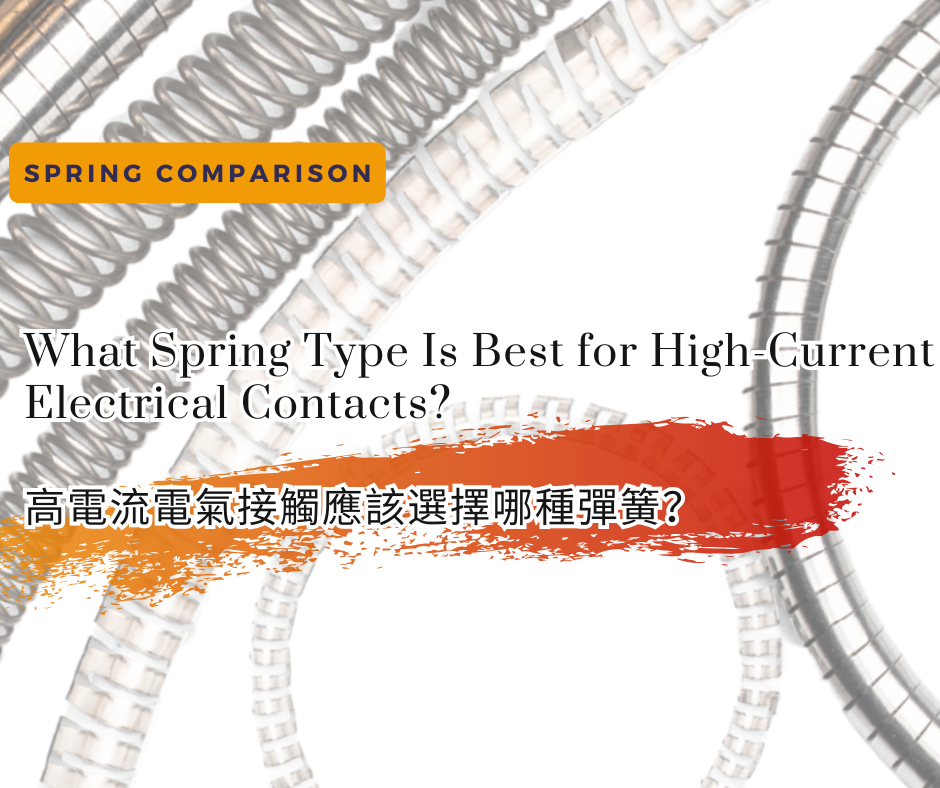
What Spring Type Is Best for High-Current Electrical Contacts?
What Spring Type Is Best for High-Current Electrical Contacts?
In high-current electrical systems, maintaining stable, low-resistance contact is critical for safety, efficiency, and long-term reliability. Applications such as EV battery connectors, power distribution units, industrial robotics, and energy storage systems all rely on consistent electrical contact under demanding mechanical and thermal conditions.
However, one of the most overlooked design decisions is this:
Which spring type should be used to maintain electrical contact under high current loads?
Choosing the wrong spring can lead to overheating, voltage drop, contact failure, and premature system degradation.
This article breaks down the three most commonly used spring technologies—canted coil springs, helical springs, and cantilever springs—and explains which is best for high-current electrical contact applications.
Why Spring Selection Matters in High-Current Systems
High-current electrical contacts are not only about conductivity. They are about maintaining:
- Stable contact force under vibration
- Low and consistent contact resistance
- Thermal stability under load
- Mechanical compliance under tolerance variation
- Long-term fatigue resistance
Even minor inconsistencies in contact force can significantly increase resistance, leading to localized heating and system inefficiency.
This is why the spring element is not just a mechanical component—it is a critical part of the electrical performance system.
1. Canted Coil Springs: The Best Choice for High-Current Stability
Canted coil springs are widely recognized as the most effective solution for high-current electrical contacts.
Unlike traditional spring designs, canted coil springs provide a near-constant force over a defined compression range.
Key Advantages:
- Stable contact force under vibration and thermal cycling
- Multiple independent contact points for improved current distribution
- Low and stable contact resistance over time
- Excellent tolerance compensation
- Suitable for conductive and EMI-sensitive environments
Why They Perform Well in High Current:
High-current systems require uniform current distribution to prevent localized heating. The multi-point contact structure of canted coil springs significantly reduces current concentration, improving both thermal and electrical stability.
Best Use Cases:
- EV battery connectors
- High-power industrial connectors
- Energy storage systems
- EMI grounding interfaces
2. Helical Springs: Reliable but Limited in Electrical Contact Precision
Helical springs are one of the most common spring types used in mechanical systems. They provide predictable force behavior and good fatigue life.
Key Advantages:
- Simple and cost-effective design
- Predictable load-deflection behavior
- Good fatigue resistance in mechanical applications
Limitations in High-Current Contacts:
- Single-point or unstable contact geometry
- Force variation under compression cycles
- Not optimized for electrical contact stability
- Limited ability to manage micro-motion in connectors
Helical springs are suitable for mechanical support and buffering, but are less ideal for direct high-current electrical contact interfaces.
3. Cantilever Springs: Compact and Precision-Oriented Contact Control
Cantilever springs are commonly used in compact electrical assemblies where space is limited.
Key Advantages:
- Excellent for tight mechanical packaging
- Fast response to small deflections
- Suitable for precision contact alignment
Limitations in High-Current Systems:
- Limited force uniformity
- Lower fatigue margin under high load cycling
- Less effective current distribution compared to multi-point designs
- More sensitive to manufacturing tolerances
Cantilever springs are best suited for signal-level or precision positioning applications rather than high-current power interfaces.
Comparison Summary
| Spring Type | High-Current Suitability | Contact Stability | Electrical Performance |
|---|---|---|---|
| Canted Coil Spring | Excellent | Very High | Excellent |
| Helical Spring | Moderate | Medium | Limited |
| Cantilever Spring | Low–Moderate | Medium | Moderate |
Key Engineering Insight: Current Distribution Matters
In high-current systems, failure is rarely caused by conductivity alone.
The real issue is:
uneven current distribution at the contact interface
This leads to:
- Localized heating
- Accelerated material degradation
- Increased contact resistance over time
Canted coil springs address this problem by distributing force and contact points more evenly across the interface.
Why Engineers Are Shifting Toward Canted Coil Spring Technology
Across EV, energy storage, and industrial power systems, engineers are increasingly adopting canted coil spring technology because it solves multiple failure modes simultaneously:
- Vibration-induced contact loss
- Thermal expansion mismatch
- Tolerance stack-up issues
- Long-term force relaxation
- Electrical instability under load
This makes it one of the most reliable solutions for next-generation high-current connectors.
How Ivex Supports High-Current Contact Design
Ivex specializes in engineered spring solutions for high-performance electrical systems, including:
- Custom canted coil springs for high-current and EMI applications
- Precision helical springs for mechanical load and fatigue control
- High-performance cantilever springs for compact contact structures
- Force-deflection simulation and engineering validation
- Material expertise (Stainless Steel, BeCu, Elgiloy®)
- Tight-tolerance manufacturing for consistent electrical performance
Instead of offering only components, Ivex works with engineering teams to optimize system-level electrical contact reliability.
Conclusion
For high-current electrical contact applications, not all spring types perform equally.
- Helical springs provide mechanical reliability
- Cantilever springs offer compact precision
- Canted coil springs deliver superior electrical stability and current distribution
If your application requires long-term stability under vibration, thermal cycling, and high current load, canted coil spring technology is typically the most robust solution.
Contact Ivex
If you are designing high-current electrical connectors or evaluating spring performance for critical systems, Ivex can support your engineering needs.
Contact Ivex to explore custom canted coil spring solutions designed for high-reliability electrical contact applications.