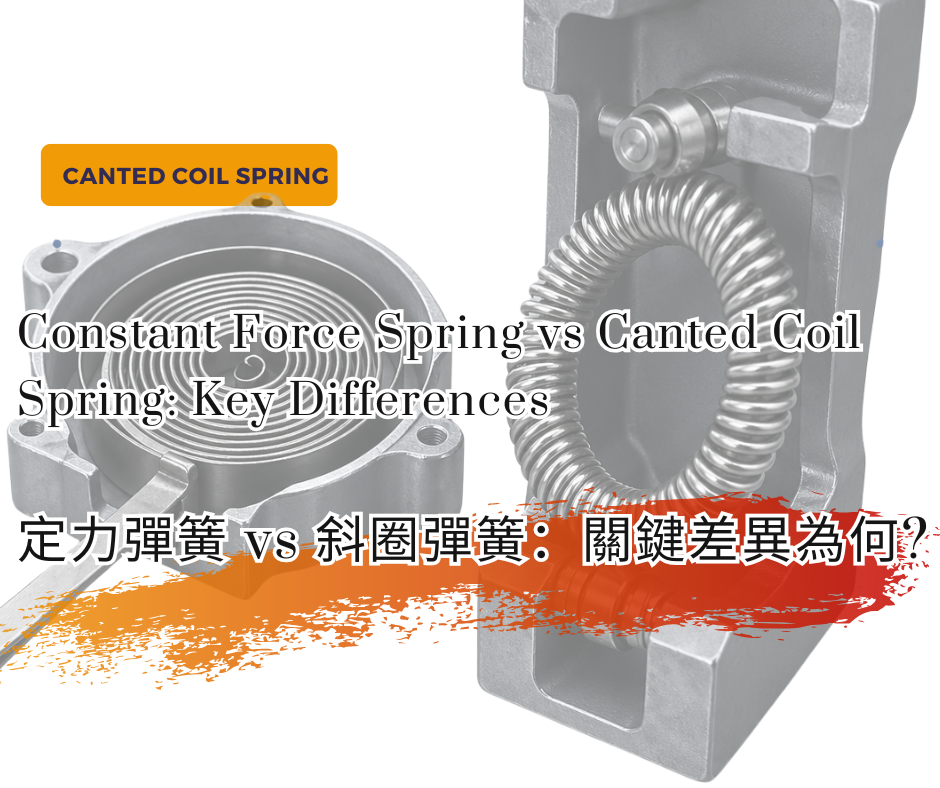
Constant Force Spring vs Canted Coil Spring: Key Differences
Constant Force Spring vs Canted Coil Spring: Key Differences
When designing for reliable mechanical performance and stable electrical contact, selecting the right spring type is critical.
Two commonly considered options in advanced engineering applications are constant force springs and canted coil springs.
While both can deliver controlled force output, their working principles, performance characteristics, and ideal applications differ significantly.
Understanding these differences helps engineers choose the right solution for long-term reliability, especially in demanding environments.
What Is a Constant Force Spring?
A constant force spring is typically made from a pre-stressed flat strip of material that is tightly wound on a drum. As the spring unwinds, it delivers a nearly constant force over its extension range.
Key Characteristics:
- Provides near-constant force during extension
- Best suited for linear motion applications
- Compact storage in coiled form
- Typically used in pull or retract mechanisms
Common Applications:
- Cable retractors
- Seat belt systems
- Tape measures
- Counterbalance systems
What Is a Canted Coil Spring?
A canted coil spring consists of individual coils that are angled (canted) relative to the spring axis. This unique geometry enables the spring to provide near-constant force within a defined compression range.
Key Characteristics:
- Near-constant force during compression
- Multi-point contact interface
- Radial or axial installation flexibility
- Capable of electrical conduction and EMI shielding
- Excellent tolerance compensation
Common Applications:
- Electrical connectors
- EMI shielding systems
- High-current contact interfaces
- Spring-energized sealing systems
Key Differences Between Constant Force Springs and Canted Coil Springs
1. Direction of Force Application
- Constant Force Spring:
Designed for linear extension (pulling force) - Canted Coil Spring:
Designed for compression (radial or axial contact force)
This fundamental difference determines how each spring integrates into a system.
2. Contact Behavior and Interface Design
- Constant Force Spring:
Typically interacts with a single contact surface or mechanism - Canted Coil Spring:
Provides multiple contact points, improving load distribution and electrical conductivity
For applications requiring stable electrical contact, this multi-point design is a major advantage.
3. Electrical Performance and EMI Capability
- Constant Force Spring:
Not typically designed for electrical conduction or shielding - Canted Coil Spring:
Commonly used for:- Electrical contact continuity
- Grounding
- EMI shielding
This makes canted coil springs highly suitable for connectors and electronic systems.
4. Tolerance Compensation
- Constant Force Spring:
Limited ability to compensate for dimensional variation - Canted Coil Spring:
Excellent tolerance compensation due to elastic deformation across multiple coils
This ensures consistent performance even with manufacturing variation.
5. Performance Under Vibration
- Constant Force Spring:
May experience instability in dynamic environments - Canted Coil Spring:
Designed to maintain stable force and contact under vibration and micro-motion
This is critical for transportation, industrial, and high-reliability applications.
6. Space Utilization and Integration
- Constant Force Spring:
Requires space for coiling and uncoiling - Canted Coil Spring:
Compact and can be integrated radially into grooves or housings
This makes canted coil springs ideal for tight assemblies.
When Should You Use Each Type?
Choose a Constant Force Spring When:
- Your application requires linear extension force
- You need a compact retraction mechanism
- Electrical performance is not a concern
Choose a Canted Coil Spring When:
- You need stable contact force in compression
- Electrical conductivity or EMI shielding is required
- The system must tolerate vibration and thermal variation
- Consistent performance across tolerances is critical
Why Canted Coil Springs Are Preferred in High-Reliability Systems
In modern engineering applications—especially in connectors, power systems, and electronic interfaces—performance requirements go beyond simple force delivery.
Engineers must consider:
- Contact stability over time
- Electrical reliability
- Environmental durability
- Manufacturing consistency
Canted coil springs address these challenges through their unique geometry and multi-functional capabilities.
How Ivex Supports Your Advanced Spring Design
Ivex specializes in engineered spring solutions for demanding applications, including:
- Custom canted coil springs for electrical contact and EMI shielding
- Precision helical springs for load control and fatigue resistance
- High-performance cantilever springs for compact and dynamic systems
- Force-deflection simulation and engineering validation
- Material selection (stainless steel, BeCu, Elgiloy®) based on application needs
- Consistent manufacturing with tight tolerance control
By focusing on real-world performance rather than just theoretical design, Ivex helps engineers achieve reliable, scalable solutions.
Contact Ivex
If you are evaluating spring solutions for connectors, EMI shielding, or high-performance systems, Ivex can help.
Contact Ivex to explore custom-engineered spring solutions tailored to your application requirements.