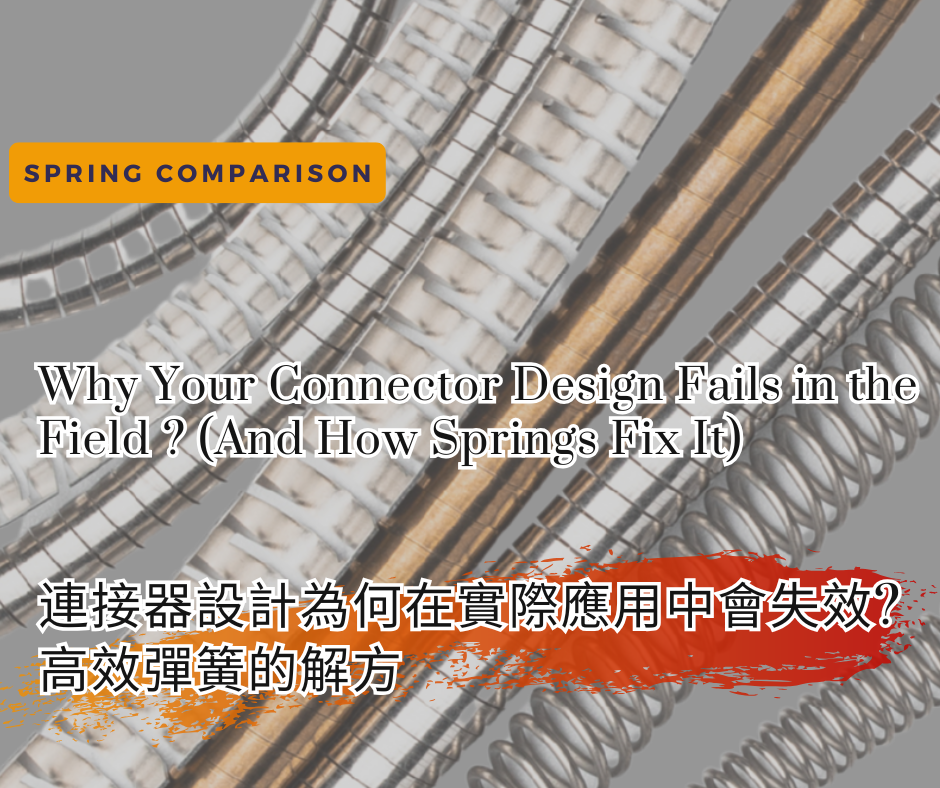
Why Your Connector Design Fails in the Field ? (And How Springs Fix It)
Why Your Connector Design Fails in the Field ? (And How Springs Fix It)
In controlled lab environments, connector designs often perform exactly as expected. Contact resistance is stable, insertion force is within specification, and durability targets appear achievable.
Yet once deployed in real-world conditions, many connectors begin to fail, sometimes gradually, sometimes unexpectedly.
Understanding why connector designs fail in the field is critical for engineers aiming to improve reliability, reduce warranty costs, and ensure long-term performance.
In many cases, the root cause is not the connector housing or contact material—but the spring system inside it.
The Gap Between Lab Testing and Real-World Conditions
Most connector validation focuses on initial performance under controlled conditions. However, real-world environments introduce variables that are difficult to fully replicate:
- Continuous vibration and mechanical shock
- Thermal cycling and material expansion
- Humidity, dust, and contamination
- Repeated mating and unmating cycles
These factors place dynamic stress on the contact interface—where stable force and consistent conductivity are essential.
Without proper spring design, even a well-engineered connector can degrade over time.
Common Failure Modes in Connector Systems
1. Loss of Contact Force
Stable contact force is essential for maintaining low electrical resistance. In many designs, traditional spring elements (or insufficient spring structures) cannot maintain consistent force over time.
This leads to:
- Increased contact resistance
- Signal instability or power loss
- Localized heating
2. Fretting and Micro-Motion Wear
Under vibration, even microscopic movement between contact surfaces can cause fretting wear.
Over time:
- Oxidation builds up at the interface
- Debris accumulates
- Conductivity degrades
This is one of the most common yet overlooked causes of intermittent failure in connectors.
3. Thermal Expansion Mismatch
Different materials expand and contract at different rates under temperature changes.
Without proper compliance in the contact system:
- Gaps may form at the interface
- Contact force fluctuates
- Long-term reliability decreases
4. Poor Tolerance Compensation
Manufacturing variations are inevitable. If the connector design cannot compensate for dimensional tolerances:
- Contact force becomes inconsistent across units
- Assembly variation increases
- Field performance becomes unpredictable
5. Fatigue and Mechanical Degradation
Repeated cycles of compression, vibration, and thermal stress can lead to spring fatigue.
This results in:
- Permanent deformation
- Reduced force output
- Shortened service life
The Root Cause: Inadequate Spring Design
In many failed connector systems, the issue is not the concept—but the choice of spring technology.
Traditional approaches, such as simple compression springs or stamped contacts, often cannot simultaneously provide:
- Stable contact force
- Vibration resistance
- Thermal compensation
- Long fatigue life
- Consistent performance across tolerances
This is where advanced spring solutions become essential.
How Engineered Springs Solve These Problems
Canted Coil Springs: Stable Force and EMI Performance
Canted coil springs provide near-constant force over a defined deflection range.
Key advantages:
- Maintains stable contact force under vibration
- Provides multi-point contact for improved conductivity
- Supports EMI shielding and grounding applications
- Compensates for dimensional variation
These characteristics make canted coil springs ideal for high-reliability connectors, especially in high-current or EMI-sensitive environments.
Helical Springs: Predictable Force and Fatigue Resistance
Helical springs offer well-understood force-deflection behavior and strong fatigue performance.
They are commonly used for:
- Controlled load applications
- Mechanical buffering and stroke management
- Supporting repeated mating cycles
When properly designed, helical springs provide durability and predictable performance in demanding environments.
Cantilever Springs: Precision and Space Efficiency
Cantilever springs are ideal for applications with limited installation space and high precision requirements.
Benefits include:
- Compact design for tight assemblies
- Fast response to small deflections
- Effective positioning and retention support
They are often used to stabilize contact interfaces and reduce micro-motion in connector systems.
From Components to System-Level Reliability
The most reliable connector designs do not rely on a single spring type. Instead, they integrate multiple spring technologies to address different functional requirements:
- Canted coil springs for consistent electrical contact and EMI shielding
- Helical springs for load control and mechanical protection
- Cantilever springs for positioning and vibration stabilization
This system-level approach ensures that performance is maintained across real-world conditions—not just in the lab.
Why Spring Engineering Matters More Than You Think
Connector reliability is not just about materials or geometry—it is about how force is generated, maintained, and distributed over time.
A well-designed spring system can:
- Reduce contact resistance variation
- Improve vibration durability
- Extend service life
- Enhance overall system stability
Ignoring spring design often leads to costly redesigns and field failures.
How Ivex Supports High-Reliability Connector Design
Ivex focuses on engineered spring solutions that address real-world performance challenges.
Capabilities include:
- Custom canted coil spring design for electrical contact and EMI applications
- Precision helical spring engineering for fatigue and load control
- High-performance cantilever spring solutions for compact systems
- Force-deflection simulation and validation
- Material selection (stainless steel, BeCu, Elgiloy®) based on environment and function
- Consistent manufacturing with tight tolerance control
By working closely with design engineers, Ivex helps transform connector performance from “works in testing” to “reliable in the field.”
Conclusion
Connector failures in the field are rarely random. They are typically the result of force instability, vibration, thermal effects, and inadequate spring design.
By understanding these failure mechanisms and adopting advanced spring technologies—such as canted coil springs, helical springs, and cantilever springs—engineers can significantly improve reliability and performance.
Contact Ivex
If your connector design is facing challenges with contact stability, vibration, or long-term reliability, Ivex is here to help.
Contact Ivex to explore custom spring solutions and improve your connector performance in real-world conditions.