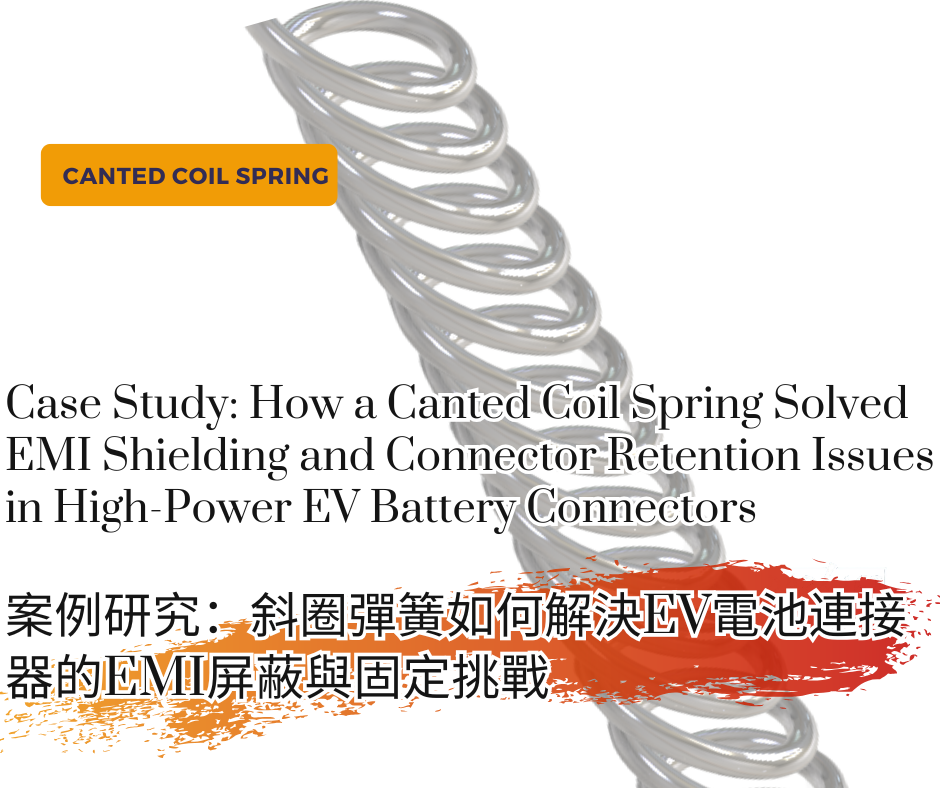
Case Study: How a Canted Coil Spring Solved EMI Shielding and Connector Retention Issues in High-Power EV Battery Connectors
Case Study: How a Canted Coil Spring Solved EMI Shielding and Connector Retention Issues in High-Power EV Battery Connectors
In high-power EV battery connectors, maintaining stable electrical contact under extreme temperature cycling, vibration, and high current loads is one of the most challenging engineering problems.
Design engineers must simultaneously address:
-
EMI shielding effectiveness
-
Contact force stability
-
Thermal expansion compensation
-
Vibration resistance
-
Long-term fatigue reliability
This case study explains how a custom canted coil spring solution resolved persistent EMI shielding and connector retention failures in a high-current EV battery system.
Application Background
The customer was a Tier-1 EV battery connector manufacturer supplying:
-
Electric buses
-
Commercial EV platforms
-
Large energy storage vehicle systems
The connector operated under:
-
Continuous current loads above 300A
-
Temperature cycling from −40°C to +125°C
-
High-frequency vibration during vehicle operation
-
Moisture and dust exposure in outdoor environments
The connector required a spring component to perform three critical functions:
-
Maintain stable electrical contact pressure
-
Provide reliable EMI shielding continuity
-
Compensate for dimensional variation caused by thermal expansion
The Engineering Problem
The original design used a traditional compression spring combined with stamped contact fingers.
Initial lab validation was acceptable.
However, after field deployment, several issues appeared:
1. EMI Shielding Degradation
Under temperature cycling, contact pressure decreased due to material relaxation.
This caused:
-
Increased contact resistance
-
Reduced shielding effectiveness
-
Intermittent electrical noise
2. Connector Retention Instability
Vibration testing revealed micro-movement at the contact interface.
This resulted in:
-
Fretting wear
-
Oxidation at contact points
-
Gradual loss of retention force
3. Inconsistent Batch Performance
Batch-to-batch spring variation led to uneven contact force distribution.
Assembly teams reported:
-
Variable insertion force
-
Connector misalignment issues
-
Higher rework rates
Simply increasing initial preload force created a new problem:
excessive insertion force that negatively affected assembly efficiency.
The design reached a structural limitation.
Ivex Engineering Approach
Instead of replacing the spring with a stronger compression spring, Ivex conducted a system-level engineering review:
-
Required contact force vs. deflection curve
-
Available installation space
-
Electrical continuity requirements for EMI shielding
-
Thermal expansion delta between mating components
-
Vibration spectrum and fatigue life target
Finite element simulation and force curve modeling showed that a near-constant force profile would significantly improve both EMI stability and retention performance.
The Solution: Custom Canted Coil Spring Integration
Ivex proposed a custom canted coil spring (C springs) manufactured from high-conductivity beryllium copper (BeCu), optimized for:
-
Constant force output over wide deflection range
-
Multi-directional compliance
-
Low stress concentration
-
High fatigue resistance
-
Electrical conductivity for EMI shielding continuity
Material options evaluated included:
-
Stainless steel for corrosion resistance
-
BeCu for conductivity and fatigue performance
-
Elgiloy® for extreme temperature stability
The final design incorporated:
-
Precision coil geometry for stable radial force
-
Tight dimensional tolerance control
-
Controlled heat treatment for force repeatability
Validation & Performance Results
After three design iterations and accelerated testing, the new connector assembly achieved:
-
40% improvement in contact resistance stability
-
3× increase in vibration endurance life
-
Stable force retention after 1,000+ thermal cycles
-
Reduced insertion force variation
-
Significant reduction in field return rate
Most importantly, EMI shielding continuity remained consistent across temperature extremes and mechanical stress conditions.
Why Canted Coil Springs Are Ideal for High-Power EV Connectors
Compared to traditional compression springs, canted coil springs offer:
-
Near-constant force characteristics
-
Superior fatigue life under vibration
-
Better compensation for dimensional tolerance stack-up
-
Enhanced electrical contact continuity
-
Compact radial installation capability
For high-current EV battery connectors, these properties directly translate into improved reliability and longer service life.
Engineering Takeaways for EV Connector Design Teams
When designing high-power EV battery connectors, consider:
-
Force curve shape, not just maximum preload
-
Thermal expansion compensation capability
-
Vibration spectrum fatigue modeling
-
Electrical conductivity of spring material
-
Batch-to-batch repeatability
Spring geometry is not just a mechanical detail — it directly impacts EMI shielding and electrical system stability.
Work With Ivex
Ivex Engineering specializes in:
-
Custom canted coil springs
-
Helical springs
-
Cantilever springs
-
EMI shielding spring solutions
-
High-reliability connector spring design
If your EV connector design faces challenges in EMI shielding, contact stability, or vibration durability, contact Ivex to discuss your application requirements.